
Explore our offering
New elevators and escalators Service ModernizationYou might be interested
Major projects KONE Remote Service Predictive maintenance Solutions for greener buildings myKONE

Innovation for life
KONE has reduced our elevators’ annual energy consumption by about 90 percent since the 1980s, with help from the IGBT – a small chip with an enormous environmental impact. In the future, this award-winning innovation is expected to play a vital role in advancing renewable energy solutions.
Professor Bantval Jayant Baliga’s has been innovating since the 1980s and earned more than 100 US patents.
Professor Bantval Jayant Baliga has been called the person with the world's largest negative carbon footprint. This nickname is a testament to his invention, the Insulated Gate Bipolar Transistor (IGBT), which he developed in the 1980s. Since then, the innovation has enabled dramatic reduction in worldwide electrical energy consumption.
“When I was 21 and very naïve, I wrote in my graduate school application that I wanted to create something that would benefit humanity. This was a great aspiration, but it’s amazing that it actually came true with the IGBT. It has been beyond my wildest dreams,” says Bantval Jayant Baliga, distinguished university professor of electrical engineering at North Carolina State University.
The IGBT is a component that has revolutionized energy consumption by elevators among countless other applications many of us use daily. This year, the Indian-born electrical engineer was chosen as the Winner of the 2024 Millennium Technology Prize for his innovation. The jury recognized that the IGBT has enabled dramatic reduction in worldwide electrical consumption and enhanced the quality of human life.
“We’ve spent 40 years refining the device globally, fine-tuning the technology, tremendously bringing down its cost. That’s why the IGBT has retained dominance in the field all these years,” he tells.


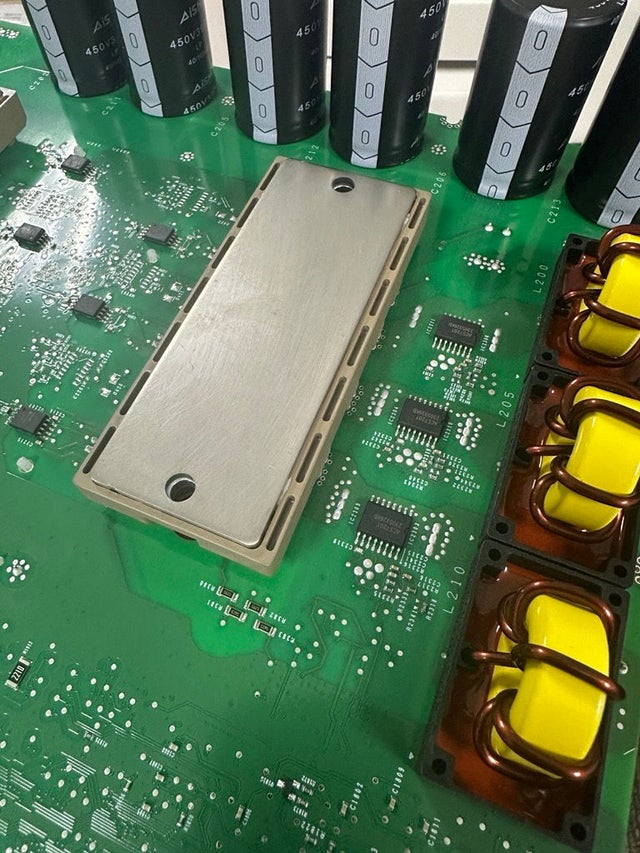
In its simplest form, the IGBT looks like a flat black rectangle with three metal pins protruding like tines of a fork. Yet, it has become an essential element of all renewable energy systems from electric vehicles, battery chargers and refrigerators, to many other household, industrial, and medical equipment – even high-speed trains and space shuttles.
Our electric cars run off DC batteries, whose power is converted by IGBT-based inverters into AC to operate the motor.
“Renewable energy systems all require using the IGBT. For example, solar produces DC voltage and current but the IGBT converts the power into the form that we use in our homes,” says Baliga.
“Wind power produces variable frequency AC current when the turbine rotates at different speeds, but you need to change that into a well-regulated power we can use. That’s all done with IGBTs; the same with wave power or geothermal. This means it will be a critical component for renewable energy well into the future.”
In the past three decades, Baliga’s design has helped cut global CO2 emissions by an estimated 82 gigatons, equivalent to three years' worth of human-generated emissions.
A modern integrated IGBT module packaging containing six IGBT’s in KONE’s drive power circuit board.
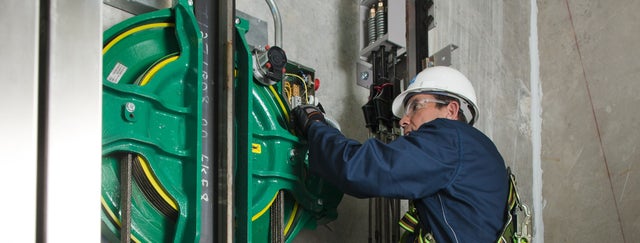
The IGBT technology is used in the variable frequency drives coupled with KONE EcoDisc® hoisting machine.
The IGBT technology has been central in the progress of KONE’s sustainable elevator design. In the mid-1990s, we broke through by coupling IGBT-based variable frequency drives with the KONE EcoDisc® hoisting machine, setting a new global standard.
“In the early 1990s, the new drives pushed our elevators to a completely new level of energy efficiency, reducing annual consumption from more than 10 000 kWh to around 6 000 kWh. Later, when we combined them with the KONE EcoDisc permanent magnet direct drive machines and microcontrollers in the mid-1990s, the figure was pushed further down to 3 000 kWh and even lower,” says Janne Rossi, head of machines & drives development at KONE.
By 2017, we had reduced the annual energy consumption of a typical European apartment building elevator by up to 90% by combining LED lighting, standby mode, and increasingly smarter features to energy-efficient motors and drives.
Since the 1990s, the IGBT technology allowed us to expand our gearless EcoDisc technology to all its elevators, offering passengers even more ride comfort and a new level of eco-efficiency. The journey continues and still today the technology powers KONE elevators, with the newest generations of drives feeding excess energy back into the building’s electrical grid.
KONE’s regenerative drives can recover up to 20-40% of an elevator system’s total energy consumption by reusing the energy generated when the elevator brakes. In the future, the increasing adoption of IGBT-enabled regenerative drives will continue to support more sustainable urban living. This will be complemented by other innovative technologies, such as ever smarter and optimized control systems, lighter elevator mechanics, and advanced hoisting technologies.
Sustainable solutions for future cities are being designed today.
“More than 30 years ago, KONE had identified the need to save electricity and develop more sustainable elevators. New designs must always reduce energy consumption compared to previous ones,” says Satu Virkkunen, head of sustainability, R&D at KONE. In her view, the IGBT fits like a glove with KONE's sustainable design principles.
“We design for lifetime. We look at the whole lifespan of the building where our equipment is installed.”
This focus is also a key part of KONE’s new strategy, which emphasizes actions to cut carbon emissions. The company wants to shape the future of cities.
“How do we make sure that we design the lowest carbon emission options for our customers? How to create an offering that is the most sustainable in our industry? Anything that we design today is for buildings that will be here for decades to come. So, we need to make sure that it will still be a sustainable solution 50 years from now.”
Bantval Jayant Baliga is keeping busy working at the age of 76, and still has his eye to the future.
“My whole life has revolved around the search for the ideal power transistor for electronic applications. And of course, you can never find the perfect ideal. But I've earned over 100 US patents trying to get better ideas, to come closer to the ideal.”
It is likely that the IGBT will continue to play a crucial role in supporting energy transition.
“Most manufacturers use the IGBT because it’s the most cost-effective, robust and very high-performance device. Since it started being widely manufactured, we've continued to work to make it even better,” Baliga concludes.
No Results Found